

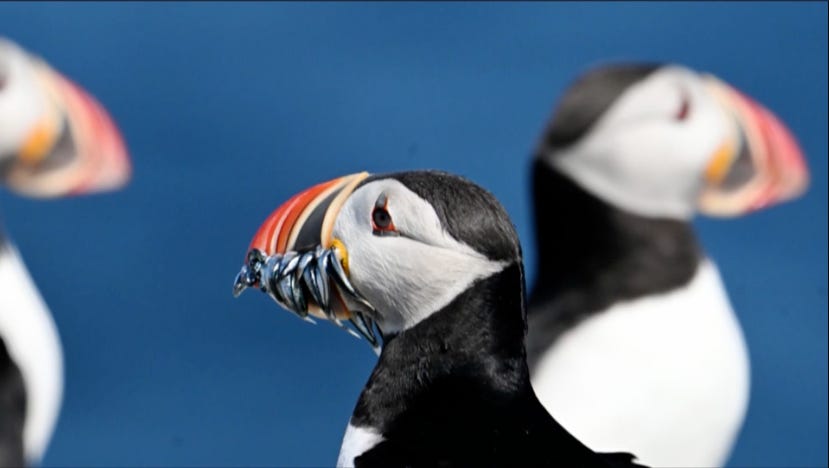
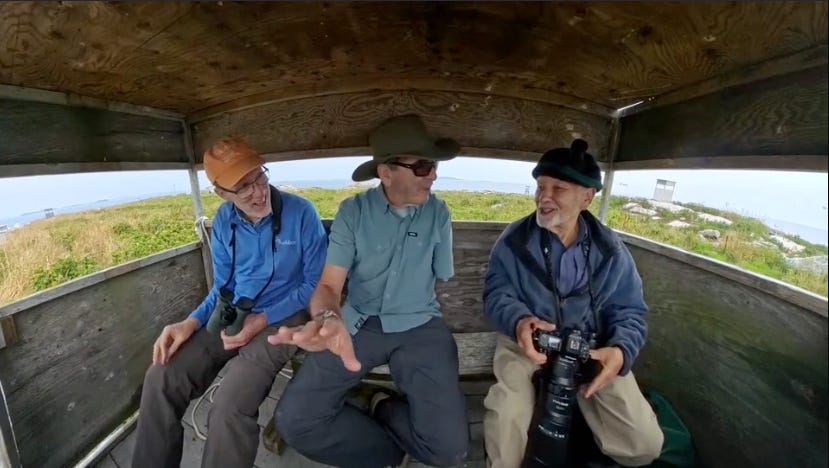
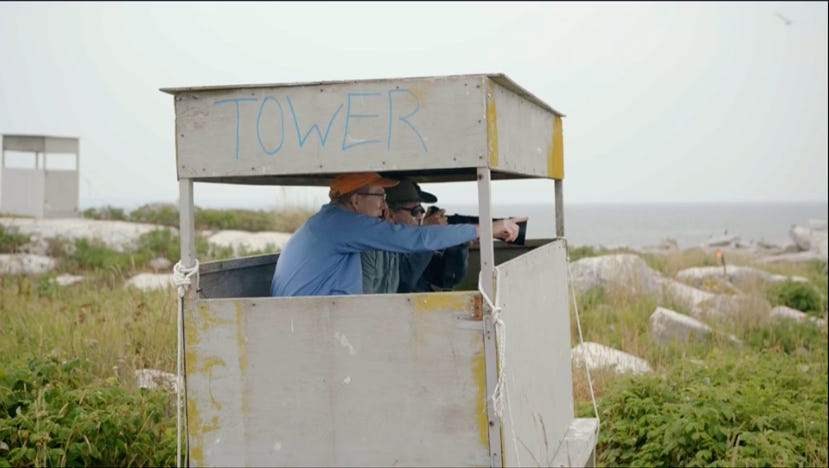
I recently found myself tucked inside a plywood bird blind on a windswept island six miles off the coast of Maine, wedged between a legend in seabird science, Steve Kress and Don Lyons, the current head of the Audubon Seabird Institute. Through a narrow gap in the blind, I had a front-row seat to one of the most remarkable conservation comebacks in the animal kingdom: puffins—dozens of them—flapping in from the sea, beaks brimming with fish for their chicks.
It was a glorious, chaotic, fishy spectacle… and a sobering one.
Because that puffin nest menu is not just baby bird chow—it’s a diagnostic tool for the health of the ocean. And the prognosis, frankly, is grim.
[You can watch my story for the PBS NewsHour above.]
The Canary in the Ocean
Seabirds like puffins, terns, and gannets are the ultimate ocean indicators. Long-lived and wide-ranging, they’re exquisitely tuned to the rhythms of marine ecosystems. When the ocean changes, seabirds are the first to sound the alarm.
And that alarm is blaring.
Over the past fifty years or so, global seabird populations have plummeted by nearly 70%. Bycatch, climate change, shifting fish stocks, avian flu, invasive predators, plastic pollution—you name it, it’s taking a toll. But this isn’t just about birds. It’s about the unraveling of a food web that ultimately sustains us all.
Project Puffin: A Comeback Story
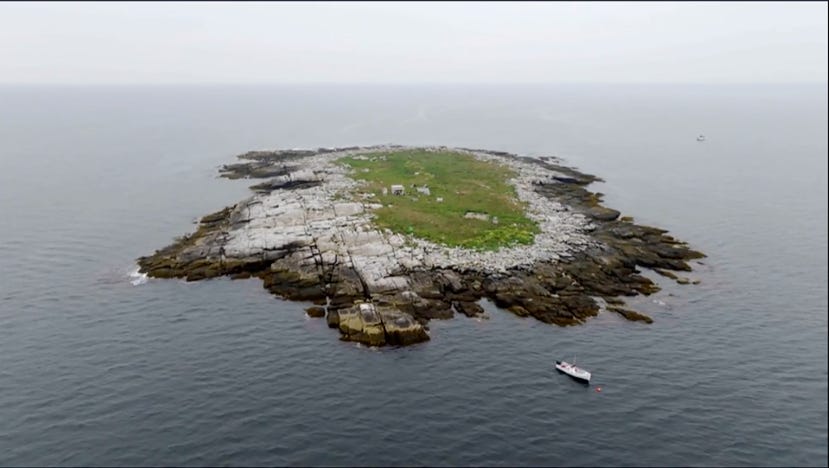
Back on Eastern Egg Rock—six miles southeast of New Harbor, Maine—the air is alive with the whir of wings and the calls of puffins. But in the early 1970s, they were absent - locally extinct, or extirpated. They were wiped out here by the late 1800s, unmercifully hunted for meat, feathers, and eggs.
Enter Steve Kress, then a 23-year-old instructor at the Audubon summer camp who stumbled across a reference to a once-thriving puffin colony on Eastern Egg. That spark turned into a radical idea: bring the puffins back.
Conventional wisdom said it couldn’t be done. Seabirds return to the colonies where they were born. But Steve and a team of young idealists imported chicks from Newfoundland, nestled them into hand-dug sod burrows, and raised them by hand. Then they waited.
To boost their odds, they used mirrors, decoys, and amplified puffin calls—tools that became the foundation of “social attraction” methods now used around the world. Four years passed before a single puffin returned. Four more before a pair bred successfully.
Fifty years later, hundreds of puffins return to Eastern Egg Rock each summer to raise their chicks. No more need for Canadian imports. The colony is now self-sustaining—by design, not by chance.
Steve has since passed the torch to Don Lyons, who continues to lead the Audubon Seabird Institute’s efforts with a new generation of biologists. But the work is far from over. The puffins are still here—but just barely.
A Delicate Balance
Watching these charismatic, slightly absurd birds struggle to deliver a single beak full of fish to their burrows was inspiring—and alarming. Puffins are built for swimming, not soaring, and they flap furiously just to stay airborne.
Their favorite fish—Atlantic herring—is moving to cooler waters as the Gulf of Maine rapidly warms. In its place? Butterfish. Oval, slippery, and too big for a chick to swallow. You can feel the heartbreak in the burrow: a well-fed parent, a starving chick, and a fish it can’t eat.
And then there are the laughing gulls—the puffins’ aerial nemeses—hovering and harassing, looking to snatch a meal before it reaches the chick.
This whole ecosystem feels precarious. And yet, it persists thanks to the vigilance of seabird stewards who camp on these islands each summer, watching, recording, and protecting. The puffin police.
Kress had hoped one day this would be a self-sustaining colony that did not require human intervention. But that will never be the case.
“If we take away the people and we, we lose these species,” says Kress. “We are the cause of the problem. We need to be the cause of the solution.”
Poop Science and Climate Truths
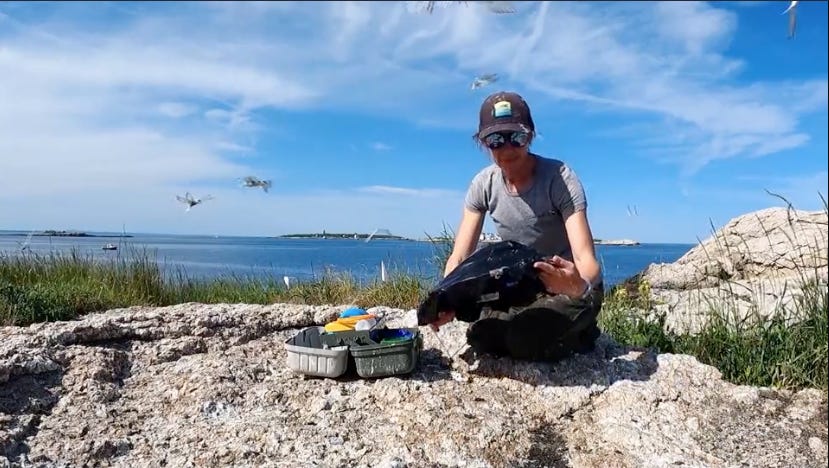
Enter Gemma Clucas, a seabird geneticist and biologist based at the Shoals Marine Lab near Portsmouth, New Hampshire. She studies the diets of seabirds by analyzing their poop.
Yes, poop.
Gemma dons a wide-brimmed hat covered in black plastic and ventures into raucous tern colonies where the droppings are plentiful. But this isn’t a stunt—it’s science. From those samples, she extracts DNA to build an incredibly detailed picture of what seabirds are eating.
This non-invasive method provides a snapshot of local fish populations over time—without ever catching a fish. It’s a way to monitor the pulse of an ecosystem from the top of the food chain down. And the data is revealing some unsettling trends: even subtle changes in prey availability can ripple through the system, affecting chick survival and reproductive success.
“Seabirds are climate change’s first responders,” Gemma told me. “They’re already living on the edge. They don’t bounce back easily.”
A Warning with Wings
That moment when a puffin flares into view with a silvery beakful of fish—it’s dazzling. But it’s also diagnostic.
What that parent brings home tells us a lot: what fish are thriving, which ones are vanishing, and whether the ocean is keeping pace with demand. The menu in a puffin’s beak is a running tally of climate change’s impact.
And the tally doesn’t look good.
Still, there’s hope in persistence—in the biologists who guard the colony, in the scientists decoding fish DNA from poop, in the birds themselves. The Gulf of Maine is heating up. The pressure is on. But the puffins haven’t given up.
They have a foothold here. Not by chance. By design.
If we pay attention to what’s in their beaks, we just might figure out how to save the ocean—and ourselves—before the tide turns for good.
Such a great story, Miles! And very "Milesy" to slip those subtle bird puns throughout the piece. Well done!
Should we start "feeding" Nature? We take so much from "it". It feeds us. I think we have a obligation, with our 8 billion + mouths, to share some of the resources we massively take out. We need to replenish the food web.